

The Union Budget 2026-27 presented on 1 February 2026 has set the stage for a significant expansion in government procurement. With capital expenditure raised to ₹12.2 lakh crore (up from ₹11.2 lakh crore last year), a ₹10,000 crore SME Growth Fund, and a structural overhaul of MSME financing through TReDS and CGTMSE reforms, businesses that participate in government tendering stand to benefit from an unprecedented volume of new opportunities.
This article breaks down the key budget announcements that will directly impact the government tendering pipeline, from sector-wise capex allocations to procurement policy changes that make it easier for MSMEs to compete and win contracts.
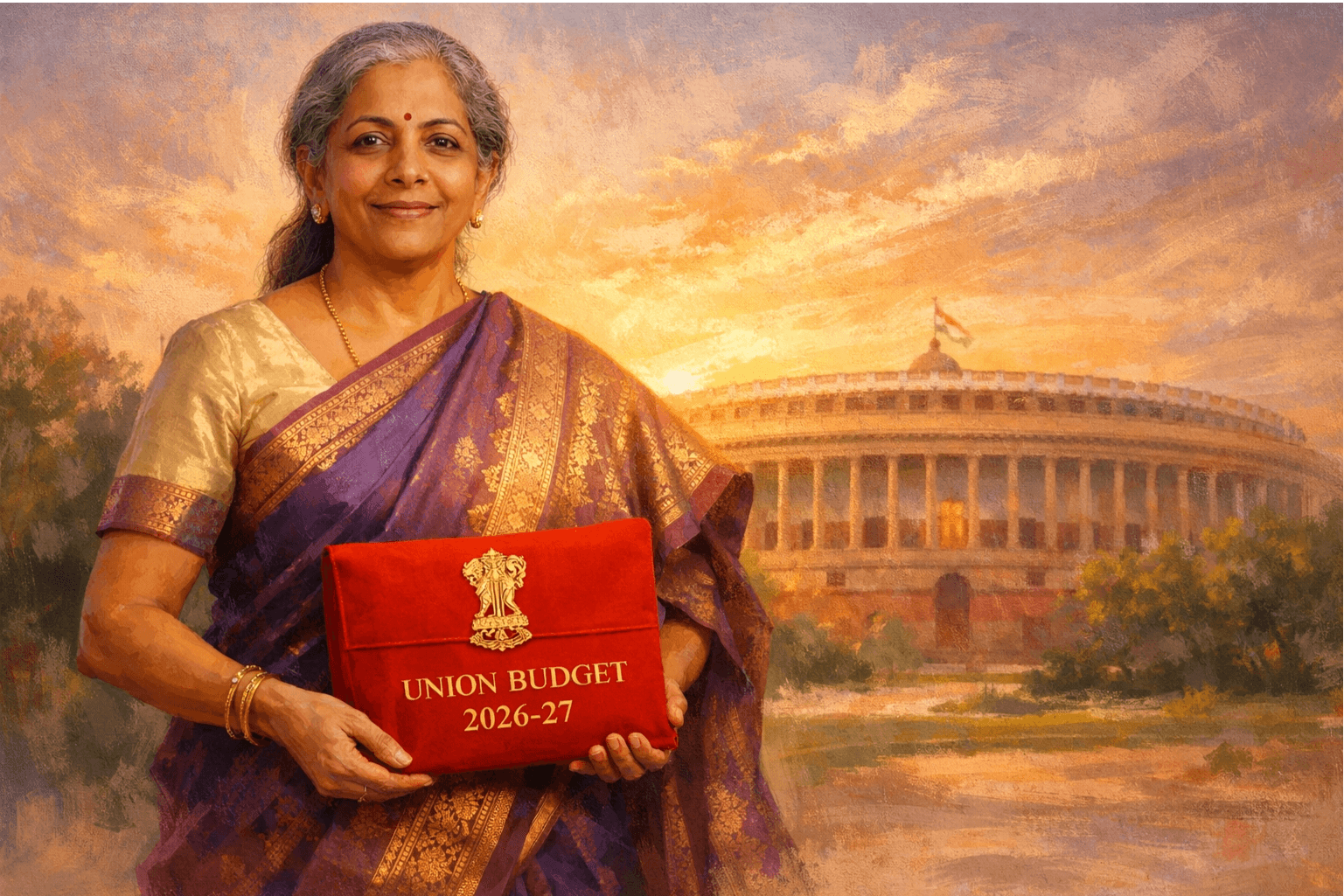
Record Capital Expenditure = Record Tender Pipeline
The government has allocated ₹12.2 lakh crorefor capital expenditure in FY 2026-27, up from ₹11.2 lakh crore in FY26 and a dramatic increase from ₹2 lakh crore in 2014-15. This capex flows directly into infrastructure projects that are procured through government tenders. India's real GDP growth for FY27 is projected at 6.8–7.2%.
The major sector-wise allocations are:
| Sector | Allocation (₹ Cr) | Key Focus Areas |
|---|---|---|
| Defence | 7,85,000 | Modernisation, indigenous procurement, border infrastructure |
| Railways | 2,78,000 | New lines, electrification, station redevelopment, Vande Bharat |
| Roads & Highways | 2,87,000 | National Highways, Bharatmala Phase 2, expressways |
| Urban Development | 95,000+ | Smart Cities 2.0, metro expansion, water supply |
| Rural Development | 1,78,000+ | PMGSY roads, rural housing, sanitation |
| Education & Health | 1,50,000+ | New institutions, hospital upgrades, digital infra |
Each of these allocations translates into thousands of individual tenders across central and state government agencies. Defence procurement alone, with its growing emphasis on indigenisation, will generate a large volume of tenders on platforms like GeM, DPSU portals, and eProcure.
New Infrastructure Initiatives = New Tender Categories
Beyond the headline capex numbers, the budget announced several new initiatives that will create entirely new categories of tenders:
- Jal Jeevan Mission Phase 2— Extending piped water supply to remaining rural households. Expect water infrastructure tenders across states.
- PM Gati Shakti integration— Multimodal connectivity projects linking ports, airports, rail, and highways under a unified planning framework.
- Green Energy Corridor expansion— Transmission infrastructure for renewable energy evacuation, targeting 500 GW non-fossil capacity.
- Smart Cities 2.0— Next phase of urban transformation covering digital infrastructure, waste management, and urban mobility.
- Industrial corridor development— New industrial nodes along dedicated freight corridors with associated infrastructure.
- Semiconductor manufacturing incentives— Fab construction and ecosystem development tenders under the India Semiconductor Mission.
- Digital Public Infrastructure— Cloud, AI, and data centre projects for government digital services.
Businesses that position themselves early in these emerging categories will have a first-mover advantage as tenders are published in the coming months.
MSME Reforms: A Three-Pillar Strategy for “Champion” SMEs
Finance Minister Sitharaman described MSMEs as a “vital engine of growth” — the sector accounts for 31% of GDP, 35% of manufacturing, and nearly 49% of exports, with over 7.47 crore enterprises employing 32.8 crore people. The budget lays out a three-pillar framework — equity support, liquidity access, and compliance assistance — to help MSMEs evolve from small suppliers into scalable “champions.”
Pillar 1: Equity Support — ₹10,000 Cr SME Growth Fund
The headline announcement is a dedicated ₹10,000 crore SME Growth Fundto provide equity and quasi-equity capital to promising MSMEs based on select criteria. This marks a deliberate policy shift away from debt-heavy support — giving MSMEs the growth capital they need to scale operations and take on larger government contracts without over-leveraging their balance sheets.
Additionally, the Self-Reliant India (SRI) Fund, set up in 2021 to support micro enterprises, will receive a ₹4,000 crore top-up in FY27 to maintain access to risk capital for smaller firms.
Pillar 2: Liquidity Access — Four Major TReDS Reforms
Cash flow has been the single biggest barrier preventing MSMEs from bidding on government contracts. The budget tackles this head-on with four reforms to the Trade Receivables Discounting System (TReDS):
- Mandatory TReDS for CPSEs— All Central Public Sector Enterprises must now settle MSME purchases through TReDS, setting a benchmark for private corporates. MSMEs supplying to the government can discount invoices and get paid faster.
- CGTMSE credit guarantee for TReDS— A new credit guarantee mechanism through CGTMSE will cover invoice discounting on TReDS, reducing risk for financiers and making more capital available to smaller suppliers.
- GeM-TReDS linkage— The Government e-Marketplace (GeM) will share procurement data directly with TReDS financiers, enabling quicker and cheaper financing for MSMEs fulfilling government orders.
- Securitisation of receivables— TReDS receivables can now be converted into asset-backed securities, creating a secondary market that improves liquidity and accelerates settlement for MSMEs.
Pillar 3: Compliance Support — ‘Corporate Mitras’
Recognising that regulatory compliance is a significant hurdle for smaller firms, the budget introduces ‘Corporate Mitras’— accredited para-professionals trained through short-term modular courses designed by ICAI, ICSI, and ICMAI. These Corporate Mitras will operate in Tier-II and Tier-III towns, helping MSMEs meet regulatory and compliance requirements at affordable costs. For businesses new to government tendering, this makes it significantly easier to handle the documentation and compliance that tenders require.
Enhanced Credit Guarantees (CGTMSE)
The CGTMSE guarantee ceiling has been raised to ₹10 croreper borrower (up from ₹5 crore), with the guarantee fee reduced to as low as 0.37% per annum. Startups now get guarantee cover up to ₹20 crore, and coverage for women-led enterprises has been raised from 85% to 90%. First-time women, SC, and ST entrepreneurs can access term loans up to ₹2 crore with targeted support.
MSME Classification Limits Raised
Building on last year's announcement, the revised MSME classification thresholds (effective April 2025) now allow significantly larger firms to retain MSME status and its associated benefits in government procurement:
| Category | Investment Limit | Turnover Limit |
|---|---|---|
| Micro | ₹2.5 Cr (was ₹1 Cr) | ₹10 Cr (was ₹5 Cr) |
| Small | ₹25 Cr (was ₹10 Cr) | ₹100 Cr (was ₹50 Cr) |
| Medium | ₹125 Cr (was ₹50 Cr) | ₹500 Cr (was ₹250 Cr) |
This means more firms qualify for the 25% MSME procurement mandate on government tenders, expanding the pool of eligible bidders while letting growing firms retain preferential access.
Key Takeaway: Budget 2026-27 moves beyond incremental credit support to a structural overhaul — ₹10,000 crore equity fund, mandatory TReDS with CGTMSE backing, GeM integration, receivables securitisation, and on-the-ground compliance help via Corporate Mitras. For MSMEs in government tendering, the cash flow and compliance barriers have been substantially reduced.
What This Means for Your Business
Whether you're an established government contractor or looking to enter the government procurement space for the first time, here are the practical takeaways:
- Volume is increasing— The record capex means more tenders across every sector. Set up keyword alerts for your areas of expertise to catch opportunities early.
- New sectors are opening up— Green energy, semiconductors, and digital infrastructure are creating tender categories that didn't exist a few years ago. Diversifying into adjacent sectors can expand your pipeline.
- MSMEs have structural support now— With mandatory TReDS for CPSEs, CGTMSE-backed invoice discounting, GeM-TReDS linkage, and credit guarantees up to ₹10 crore, the cash flow barriers that kept smaller firms out of government tendering have been substantially reduced.
- Defence procurement is growing— The push for indigenous manufacturing (Make in India for defence) means more tenders are open to private sector companies.
- State-level opportunities multiply— Central allocations flow through to state governments. Monitor state eProcure portals alongside central platforms.
Stay Ahead of New Opportunities
Tenderkart aggregates tenders from 180+ government portals, updated daily. Set up alerts for your keywords and never miss a relevant tender from the Budget 2026-27 pipeline.
Search Government Tenders